Tuesday, February 23, 2010

Are We Beating Ourselves?

The new feature popping up in supermarkets and grocery stores around the country is the self-scanning checkout option. A great invention, and something that significantly saves time and speeds up the shopping experience, this sped up option is a feature that has been a long time coming.


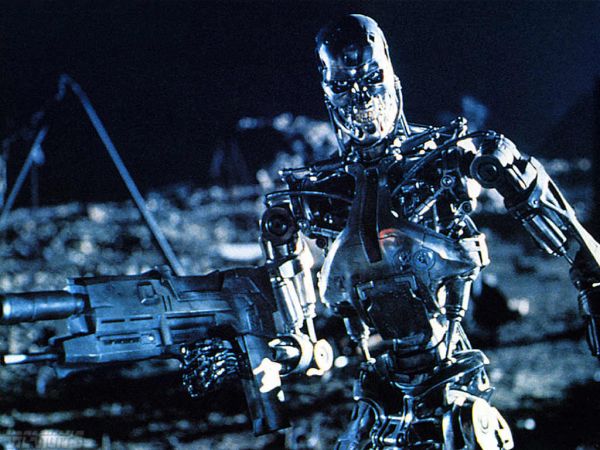
While it is indeed revolutionary, there is an aura of too much too soon, in my opinion. There are still workers working many of the checkout lines, but I worry that soon enough they will be replaced by machines. Are we really going the way of Terminator? Highly doubtful. But it is bothersome when you see how our technology is hurting our economy.


I have not personally cheated the self-scanning checkout station, but from looking at how it is layed out and how one uses the machine, it looks fairly easy to "forget" to check out the sweet potatoes you just bought. What do stores do if there is no bar code on the food you just bought? There is a way for people to type in their food and weigh it, but what's stopping them from taking a small piece of produce?


I fear that we are maxing ourselves out. That our technology is moving too fast, and the jobs that once filled the country, are now being lost to a cheaper more accurate option. Not just with the self-scanning checkout option, but with other things as well. Record stores and book stores are becoming rapidly extinct due to IPods, legal/illegal downloading, Amazon/Ebay/Half.com, and the Kindle/Nook. Personally, I do not like the idea of owning an ebook reader over a solid book. Book's were made to be read on binded paper, not an electronic screen.


On a personal note, my grandparents own a pharmacy in Bangor, ME. It has been the best independently owned pharmacy since they first started in 1957. A few years ago they purchased a robot to assist in counting large quantities of pills to fill orders. They still have a large staff, who many are still instructed to count pills for orders. The robot, however, has saved money and time. Our economy has obviously hit a snag, and there is a legitimate claim to worry about maxing our technology out, and taking away people's jobs.


We are entering a time where certain tools are becoming necessities, not just for the wealthy, but for every member of society. I consider credit cards to be rather essential, and I consider having a computer and knowing how to work its basic functions as being an absolute necessity. Everyone should have a computer in today's world. There are too many everyday functions that are being used on computers, and they make life simpler (despite how frustrating they are at times).


There are, and will always be problems with the self-scanning checkout lines. Machines were made to be perfect and fast, but also have been known to collapse or falter. Some stores don't keep enough cash registers open, so having the self-checkout option is rather necessary. I wouldn't mind seeing more registers being open, with actual people working behind them. We should recommit ourselves as a whole to protecting jobs and limiting technologies stranglehold upon us.

Thursday, February 18, 2010

Hard Drive's Get the Boot


Not so long ago (depending on how long you think 12 years is) I remember one of the perks of the after school day care program being that they had a bunch of computers, and one of the games they had was Oregon Trail. I didn't know much about computers then (not that I know a lot now), but thought that being the carpenter from Ohio was a no-brainer compared to the banker from Boston. On top of Oregon Trail, playing soccer outside and hand hockey with a ball of masking tape equaled loads of fun.

I digress. The computer game that I somehow enjoyed playing endlessly used something that is on its way out to extinction. The game was on a floppy disk, not even a CD-Rom. It's hard to believe, but with our world becoming increasingly digital and technologically clean, the way of the floppy drive is becoming non-existent. Sure, I have a drive on my laptop from freshman year, and the computer my family just trashed had one for sure. Do today's computers still have one?

With I-Pad's, Kindle's, and who knows what else coming out at a rather frightening pace, it is clear that the past 15 years or so has seen a revolutionary change in our technology. The rapid increase in computer technology eventually put the floppy drive on the back-burner (ready to be burned). What's next to slowly fade out?

Although I'm certainly not technologically savvy by any point, I can see that the CD is being phased out, and even further, can envision the DVD being passed by as well. No one ever thought there would be a day where CD's would become obsolete, and IPod's would be owned by every single person in the country (there really is no better way than having all of your music in one place). Moving back to college, I had to bring a box full of my DVD's just so I had a few options when choosing what movie to watch.

What if there was a device, similar to the IPod, which could store your entire movie collection? There would be a way to simply plug it into your television, and you could go from there. Scroll down the screen to find "Silence of the Lambs". In the mood for something lighter? Use your fingers to find "Dumb and Dumber". I know the Blue-Ray disc has made even further improvements to our already stunning visual displays Americans are becoming accustomed to, but I can't help but believe something of this magnitude will hit our stores shelves within the next five years.

Tuesday, February 9, 2010

Will Linux supplant Windows?

To be quite honest, I had never heard the name Linux before being tasked to find more about it. Although Windows and Mac's dominate the desktop world, Linux is becoming more popular, particularly among businesses. While it has seen an increase in desktop users (with the advancement of technology), it was estimated that 60% of all web servers used Linux in 2008.

Plenty of companies are beginning to use Linux in some capacity, whether for a simple application software, or an operating system for major systems. Here are some of those businesses:
  • Amerada Hess Corporation (oil)
  • BART (Bay Area Rapid Transit)
  • Boscov's Department Stores
  • Burlington Coat Factory
  • Conoco (oil)
  • Cisco (printing)
  • Digital Domain (visual effects)
  • Ernie Ball Inc. (guitars)
  • Garden Grove, California
  • Google
  • Just Sports USA (sporting goods)
  • Kaiser Aluminum
  • Largo, Florida
  • Lawson Inc. (convenience store in Japan)
  • Government of Mexico City
  • Mobil Travel Guide (part of ExxonMobil and Forbes)
  • Omaha Steaks
  • Panasonic
  • Raymour & Flanigan (furniture)
  • Royal Dutch/Shell (oil)
  • Tommy Hilfiger
  • Toyota U.S.A.
  • Travelocity
  • U.S. Army
  • U.S. Federal Courts
  • U.S. Postal Service
  • WesternGeco (seismic contracting company)

Predictions for Linux and its immediate future appear overwhelmingly positive. It is increasing its use in the U.S. Government, and Linux Foundation President Jim Zemlin will continue to push his idea, "Linux Everywhere", for 2010. Linux Everywhere includes TV's, GPS', and tablet PC's among others. There seems to be staggering positivity surrounding Linux, and in 2010, many are predicting a positive increase in gadgets and virtualization, while it's desktop productivity will lag behind the big companies.